Understanding human skills AI cannot replace is essential for remote workers. Artificial Intelligence (AI) has rapidly transformed the remote work ecosystem. AI tools can now generate clean code, draft detailed reports, analyze complex data sets, and create stunning visual assets in seconds. As automation becomes more deeply embedded in daily workflows, many remote professionals worry about their roles becoming obsolete.
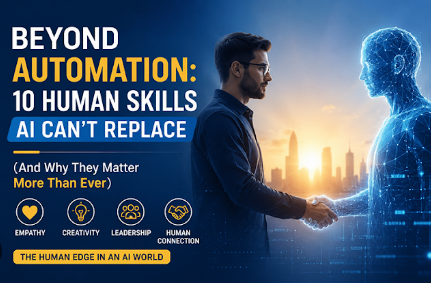
However, AI operates strictly on pattern recognition, data processing, and statistical prediction. It lacks genuine human experience, personal consciousness, and moral reasoning. For remote workers, long-term career sustainability depends on leaning into capabilities that algorithms simply cannot replicate.
Here is a breakdown of the high-value human skills that AI cannot replace and how remote workers can leverage them to remain irreplaceable in the modern workplace.
Human Skills vs. AI Capabilities Overview
| Human Skill | What AI Does | What Only Humans Can Do |
| Emotional Intelligence (EQ) | Analyzes text sentiment & voice tone | Builds genuine trust & psychological safety |
| Critical Thinking & Judgment | Generates recommendations & statistical options | Makes complex choices in ambiguous, high-stakes scenarios |
| Original Creativity | Recombines existing data patterns | Conceives out-of-the-box, novel concepts born from lived experience |
| Ethical Reasoning | Follows pre-programmed guidelines | Navigates moral dilemmas & nuanced value trade-offs |
| Strategic Leadership | Assigns tasks & tracks progress metrics | Inspires cross-functional teams & builds authentic company culture |
1. Emotional Intelligence (EQ) & Authentic Human Connection
While emotion AI can analyze text sentiment or micro-expressions, it cannot actually feel or share a human experience. Remote work relies heavily on asynchronous communication where misunderstandings occur easily. Professionals with high EQ can read between the lines, detect subtle signs of team burnout, resolve interpersonal conflicts, and foster psychological safety across distributed teams.
2. Critical Thinking in Ambiguous Situations
AI systems perform exceptionally well when clear data and defined rules exist. However, real-world business scenarios are often unpredictable, incomplete, or chaotic. Humans excel at analyzing context, evaluating subtle trade-offs, and making decisive calls when there is no single “correct” answer in the dataset.
3. Authentic Creativity & Originality
Generative AI creates content by assembling existing human-created data. True invention, strategic vision, and resonant storytelling stem from human emotions, personal perspectives, and lived experiences. Remote creators and strategists who combine AI efficiency with an original, authentic perspective will always stand out.
4. Ethical Judgment & Moral Accountability
Algorithms do not possess a conscience or an intrinsic understanding of ethics. When managing sensitive customer data, making hiring decisions, or publishing public information, companies require human judgment to prevent algorithmic bias, uphold privacy, and maintain public trust.
5. Strategic Leadership & Team Motivation
Managing remote projects involves far more than just delegating tickets or tracking deadlines. Great leaders build resilient remote cultures, align cross-functional teams around a shared vision, and provide authentic empathy during challenging organizational transitions—traits no software can replicate.
6. Negotiation & Complex Relationship Management
Whether closing high-ticket sales, managing enterprise clients, or agreeing on vendor contract terms, negotiation involves reading non-verbal cues, underlying motivators, and cultural nuances. AI can draft agreement templates, but humans close deals by building mutual trust.
7. Adaptability and Continuous Learning
While AI models operate within pre-existing data limits, humans adapt dynamically through real-world experience and proactive learning. The ability to pivot quickly, master new technologies, and unlearn outdated methods remains a vital advantage for remote professionals.
Read Also:Top 10 Free SEO Tools for Beginners in 2026
Final Thoughts
The future of work is not humans versus AI; it is humans powered by AI. By leveraging automation tools to handle administrative tasks while sharpening uniquely human traits like empathy, ethics, and critical judgment, remote workers can build resilient and future-proof careers.