Named after the trees that keep their leaves across all four seasons, evergreen traffic refers to website visits generated by content that remains continuously relevant, useful, and searched for over extended periods.
Unlike ephemeral content—such as breaking news, pop culture commentary, or temporary product launches—evergreen content addresses fundamental questions, core skills, and timeless problems that readers actively research regardless of current trends.
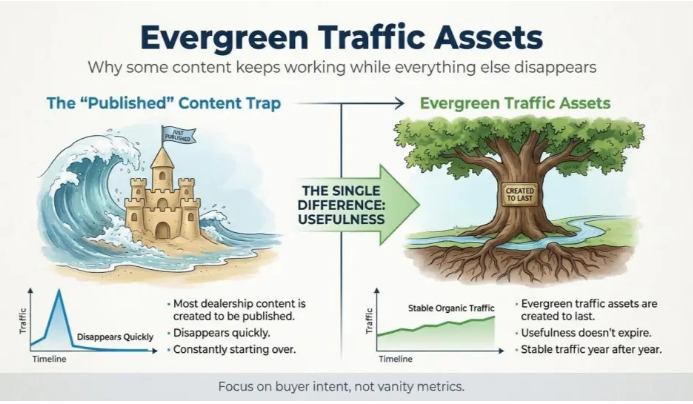
Evergreen Traffic vs. Trending Traffic
| Metric / Aspect | Evergreen Traffic | Trending (Viral) Traffic |
| Traffic Pattern | Slow initial growth, followed by consistent, compounding volume over years. | Rapid spike upon release, followed by a steep drop-off. |
| Content Longevity | Months to years with minimal maintenance. | Days to weeks before becoming obsolete. |
| Primary Sources | Organic search engines (Google, Bing), YouTube, long-tail bookmarks. | Social media feeds, news aggregators, email blasts. |
| ROI Impact | High long-term return; content cost amortizes over time. | Immediate return; requires constant new creation to sustain volume. |
Why Evergreen Traffic is Essential for Growth
Building an organic engine powered by evergreen traffic offers major strategic advantages:
- Compounding ROI: Creating content requires an upfront investment of time or money. While a news article yields traffic for only 48 hours, an evergreen guide continues to generate leads, signups, and ad revenue for years without additional production costs.
- Passive Lead & Sales Generation: Evergreen pages sit directly in the path of users searching for solutions to specific problems, making them ideal vehicles for capturing email subscribers or product sign-ups.
- Natural Backlink Accumulation: High-quality evergreen guides naturally attract external links from other websites, bloggers, and journalists seeking reliable references. These backlinks boost your entire domain’s authority in search engine rankings.
- Reduced Dependence on Ad Spend: By securing steady organic rankings for high-intent queries, you decrease reliance on expensive pay-per-click (PPC) advertising campaigns.
1.Identify Semantically Stable Topics:Step 1.
Focus on topics where the underlying mechanism or answer doesn’t change rapidly. Target fundamental “How-to” queries, industry glossaries, step-by-step tutorials, or core problem-solving guides.
2.Validate Consistent Search Demand:Step 2.
Use keyword research tools to verify that people search for the topic consistently year-round rather than in brief seasonal bursts or trend spikes. Look for stable, long-tail search volume.
3.Craft Time-Agnostic Content:Step 3.
Avoid temporary phrasing like “this year,” “recently,” or specific dates unless necessary. Write comprehensive, definitive resources that fully answer the user’s search intent in clear, scannable language.
4.Establish Strategic Internal Links:Step 4.
Connect new articles to your top evergreen assets using descriptive anchor text. Internal links pass SEO authority and guide visitors deeper into your site funnel.
5.Audit and Update Periodically:Step 5.
Schedule semi-regular content refreshes (e.g., every 6 to 12 months) to update outdated statistics, broken links, or minor details to keep rankings strong against competitors.